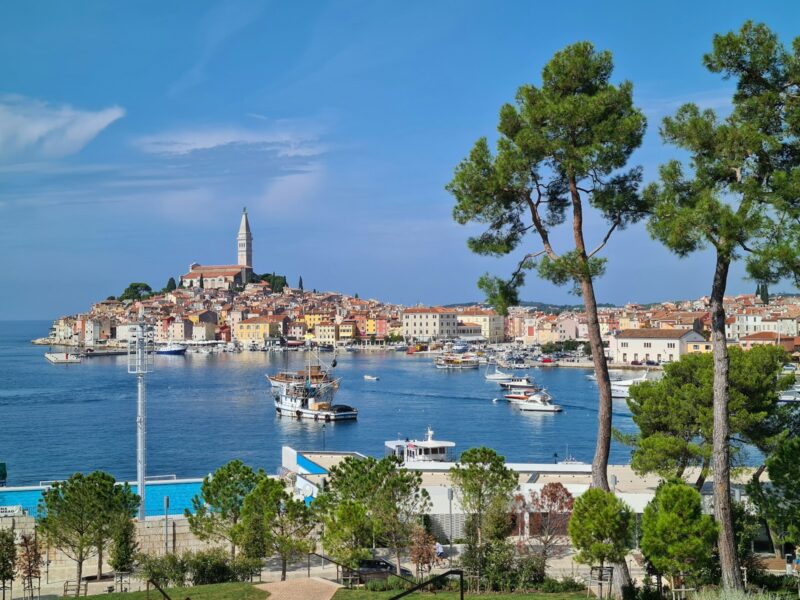
 The Istrian peninsula, in Croatia’s northwest corner, is often compared to Tuscany for its vineyards, olive groves, and medieval hill towns. But while the Italian influence is visible everywhere — in the architecture, the food, even the dialect — Istria remains unmistakably Croatian in its rhythm and character. Cycling here means moving between eras: Roman roads, Venetian towers, and quiet farming villages where time seems to have slowed.
The Hilltop Town Circuit connects the best of inland Istria — a loop through Motovun, Grožnjan, Buzet, and several smaller villages that sit above the Mirna River valley. The route is about 70 kilometers depending on detours, mostly on secondary roads with little traffic. It’s challenging in places but never extreme, and the reward is one of the most atmospheric rides in the country.
Starting in Motovun
Motovun rises sharply from the valley, surrounded by vineyards and truffle forests. The climb to the top is short but steep, winding through ancient stone gates to the old town square. From the ramparts, you can see the entire central Istrian landscape — rolling hills, red-roofed villages, and the Mirna River cutting through the valley below.
This town is the symbolic heart of inland Istria. It’s small, just a few hundred residents, but full of character. The cobbled streets are lined with wine shops and taverns offering local Malvazija and Teran wines. Early morning is quiet, with mist still hanging in the valley, and the sound of church bells echoing through the hills.
Motovun also hosts one of Croatia’s oldest film festivals each summer, turning its narrow lanes into outdoor cinemas for a week. But most of the year, it feels calm and residential, a perfect place to start the circuit.
Toward Grožnjan — The Artists’ Town
Leaving Motovun, the road descends into the valley before climbing again toward Grožnjan. This stretch passes through forests of oak and chestnut, known locally for truffles found beneath the roots. Signs along the road mark truffle farms and small family restaurants that specialize in pasta with shaved truffles and olive oil — a simple, distinctly Istrian meal.
Grožnjan is smaller than Motovun but livelier in its own way. In the 1960s, it was revived by artists who settled in abandoned stone houses and opened studios. Today, nearly every doorway in the old town hides a gallery, workshop, or small café. During summer, jazz musicians play in the courtyards and the air smells of lavender from nearby gardens.
The streets are steep and uneven, so most cyclists leave their bikes outside the old gates and explore on foot. From the western terrace, you can see all the way to the Adriatic on a clear day — the coastline dotted with white towns and blue water.
Across the Mirna Valley
From Grožnjan, the route drops back into the Mirna Valley. The descent is smooth and scenic, with long curves and little traffic. At the bottom lies the village of Livade, considered the truffle capital of Istria. The local restaurant, Zigante, even holds an annual truffle fair in autumn, attracting chefs from across Europe.
This part of the ride is easier — flat roads along the river, flanked by fields and olive trees. The contrast between the high medieval towns and the quiet valley floor shows how the region has balanced agriculture and culture for centuries.
The road then begins a gentle climb toward Buzet, another hill town surrounded by terraces and forest. The incline is steady but rewarding, and Buzet’s old quarter comes into view suddenly as you round a bend.
Buzet — Gateway to Northern Istria
Buzet is larger than the other towns and serves as a good base for exploring northern Istria. Its old core sits on a hill overlooking the valley, with a network of narrow lanes and stone houses that date back to the 15th century.
The main square is relaxed, usually filled with locals rather than tourists. There are cafés, bakeries, and small grocery shops — practical stops for anyone cycling through. The town is also known for its distilleries that produce traditional Istrian brandy (rakija) infused with herbs, honey, or mistletoe.
From Buzet, several smaller loops branch out toward villages like Sovinjak and Vrh, or deeper into the Ćićarija mountains that form the border with Slovenia. These roads are quieter and hillier, ideal for riders who want to extend their trip beyond the main circuit.
Roads, Food, and Rhythm
Cycling in inland Istria is different from the coastal experience. Here, distances are short but the climbs add up, and every stop is an opportunity to eat or talk with locals. Lunch usually means homemade pasta — fuži or pljukanci — with truffles, mushrooms, or wild asparagus in spring. Wine is poured generously, and olive oil is treated with the same respect as in Italy.
The best time to ride is from April to October, with spring and early autumn offering mild weather and fewer visitors. Traffic is light except near the coast, and the region’s cycling infrastructure improves each year, with clear signposts and repair stations on major routes.
A Regional Network
The Hilltop Town Circuit connects naturally with other cycling routes across the peninsula. From Motovun, riders can join the Parenzana Trail, a former railway line that runs from Trieste to Poreč. It’s a gravel route through tunnels, viaducts, and valleys, offering a different perspective on the same landscape.
Together, these routes form a web of trails that make Istria one of Croatia’s most rewarding regions for active travel. Many cycling holidays in Croatia include both the Hilltop Town Circuit and the Parenzana, combining culture, food, and moderate riding into a few days of travel that feels local and unhurried.
Why It’s Worth It
What makes inland Istria stand out isn’t just the scenery but the atmosphere. Each town is close to the next, yet distinct in its own way. The roads link not only places but traditions — winemaking, truffle hunting, olive oil pressing — that still define daily life here.
The Hilltop Town Circuit captures this rhythm better than any other route in the region. It’s challenging enough to feel rewarding but relaxed enough to leave time for long lunches and detours. You finish with tired legs, a few photos, and the sense of having moved through a landscape that still feels authentic — old stones, quiet hills, and the smell of pine carried on the wind.