
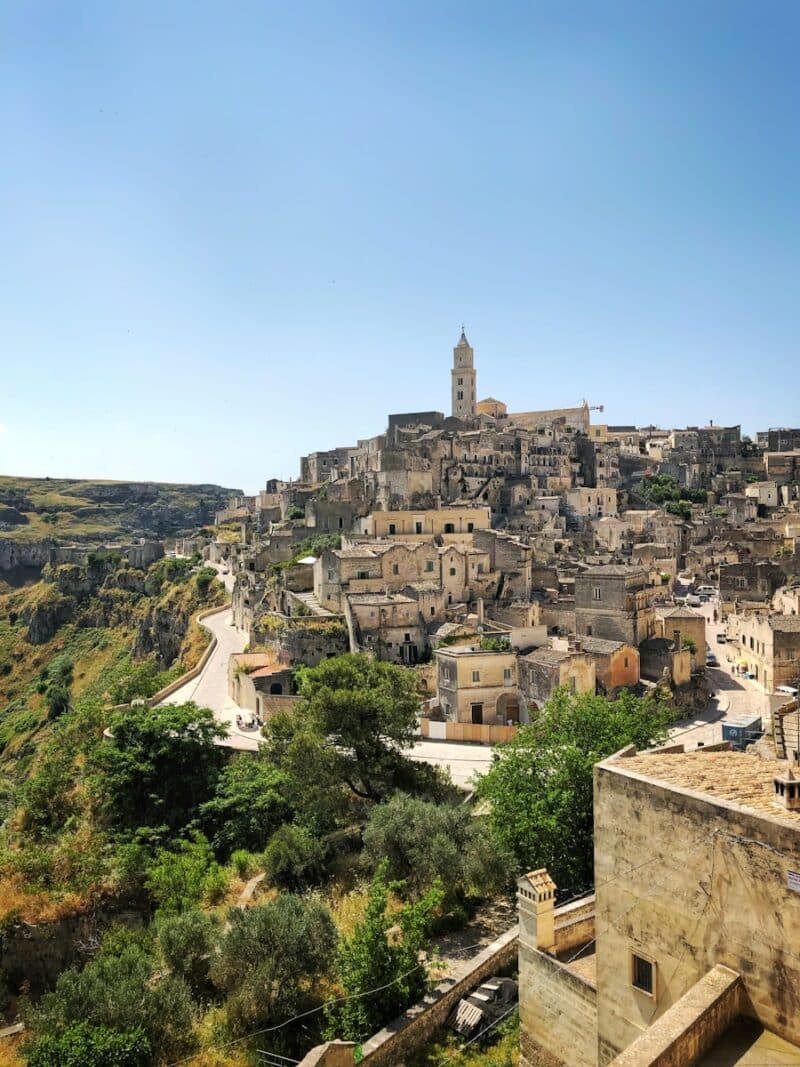
 Matera doesn’t look like a modern city. It rises from a deep ravine in southern Italy, its pale stone houses stacked unevenly like a sculpture carved by time. Walking or cycling through its ancient lanes, you quickly understand why this place feels different: for thousands of years, people have lived here in homes cut directly into the rock.
For most of the 20th century, Matera was nearly forgotten — poor, isolated, and half-abandoned. Today it’s one of the most fascinating small cities in Europe, where cave dwellings, baroque churches, and quiet piazzas sit side by side. Two days here is just enough to see its contrasts: the ancient and the new, the silence and the life returning.
Arrival and First Impressions
The train from Bari winds through olive groves and dry hills before reaching Matera Centrale, a modest station that gives no hint of what’s ahead. The city doesn’t reveal itself all at once. It begins subtly — a few narrow alleys, then a sudden drop as the land opens into a vast stone amphitheater filled with houses.
The Sassi districts, Sasso Barisano and Sasso Caveoso, form the heart of Matera’s history. Their labyrinth of passages and stairways feels almost unplanned, but the system is centuries old. Each level of the town opens to another view: laundry hanging across alleys, carved doorways, small terraces with pots of basil and fig trees.
For a first walk, start at Piazza Vittorio Veneto, then descend toward Via Fiorentini. Within minutes, you’ll be walking through a living museum — but one still full of residents, workshops, and restaurants rather than just tourists.
The Caves and Churches
Matera’s story begins with caves, and visiting at least one casa grotta (traditional cave home) is essential to understand the city’s past. These were not primitive shelters, but complete dwellings with stone beds, stables, and water systems. The best-preserved examples are open as small museums, showing how families lived here until the 1950s.
Above ground, dozens of chiese rupestri — rock-hewn churches — hide among the cliffs. Their frescoes, faded but still bright with reds and blues, show a level of artistry few expect to find in such a harsh setting. The Church of Santa Maria de Idris, built into a rock spur overlooking the ravine, combines both architecture and geology in one striking form.
Across the canyon, reachable by footpath or short drive, lies the Parco della Murgia — a protected area dotted with cave chapels and hiking trails. From its edge, the entire city appears like a honey-colored wall rising from stone, one of the best views in southern Italy.
Life in the Sassi
Despite its dramatic appearance, Matera is not a museum. Locals still live in the Sassi, often in carefully restored houses that mix old stonework with modern interiors. The upper parts of the city have cafés, bakeries, and quiet courtyards where older residents gather in the afternoons.
Evenings are slow and social. People stroll along Via Ridola, stopping for aperitivo and conversation. Trattorias serve plates of handmade orecchiette, roasted peppers, and lamb cooked with herbs. The food is simple, reflecting the region’s agricultural roots, but full of character.
At night, the city glows softly under yellow lights, the caves illuminated one by one until the entire hillside looks alive again.
Exploring Beyond the Center
A short ride outside Matera leads to open countryside marked by wheat fields and low stone walls. Many travelers rent e-bikes to explore these rural roads, which connect small farms and villages where time seems to have paused.
The most rewarding route follows the ridge toward Montescaglioso, an old hill town with a Benedictine abbey overlooking the plains. Along the way, the road passes orchards and grazing sheep, and you can hear the wind carry the sound of church bells from miles away.
This slower travel style has become popular with those on bike tours in Italy, as it connects Matera’s heritage with the surrounding Basilicata landscape — still wild, still authentic.
Morning in the New City
On the second day, climb to the modern district above the Sassi. Here, Matera looks more like a typical Italian town: tree-lined streets, markets, and bakeries filled with locals buying bread. It’s a good place to grab breakfast and see how the city functions today.
The bread itself is famous — Pane di Matera, made from durum wheat and baked in wood ovens, with a thick crust that lasts for days. Pair it with local honey or olive oil, and you’ll understand why this simple food is part of the region’s identity.
From there, return to the old town by descending one of the staircases that lead back into the Sassi. The contrast between the two worlds — the new city above and the ancient one below — defines Matera’s character.
Why Matera Matters
Matera stands out not because it tries to preserve the past, but because it has learned to live with it. The same stone caves that once symbolized poverty now host galleries, restaurants, and small hotels. The transformation didn’t erase the history; it gave it context.
You can spend hours exploring, but what lingers most is the atmosphere — the mix of silence, wind, and stone that no photograph quite captures. Few places show the layers of human adaptation as clearly as Matera, from prehistoric shelters to modern homes.
For travelers interested in history, architecture, or simply places that feel unlike anywhere else, this city offers all three in one small area. And for cyclists, it’s a reminder that not every great ride is about distance — sometimes it’s about moving slowly enough to feel the texture of the land beneath your wheels.


1 comment
Nice work buddy, Its amazing all details available here is very unique The healthy Voyager aims to help people live well one veggie at a time.