 Granada is a city built on slopes — a mix of narrow alleys, viewpoints, and cobbled climbs that seem made for getting lost. While many visitors explore it on foot, cycling through its older quarters gives a different perspective: the sound of tires on stone, the smell of jasmine from hidden courtyards, and the view of the Alhambra appearing and disappearing between whitewashed walls.
The two neighborhoods that define this experience are Albaicín and Sacromonte. Both sit on the hills opposite the Alhambra, and both tell the story of Granada’s long, layered history — Moorish, Roma, Andalusian — still alive in daily life.
The Albaicín — Granada’s Oldest Quarter
The Albaicín is the oldest part of the city, a dense maze of streets that dates back to the 13th century. It once served as the Moorish residential area during the Nasrid dynasty, and its layout has hardly changed since.
Cycling here means adjusting your pace. The roads are narrow and steep, sometimes only wide enough for a single car. But on an e-bike or lightweight city bike, it becomes manageable — more like gliding between layers of time than racing through traffic.
The route starts near Plaza Nueva, the flat area at the base of the hill, and winds upward along Carrera del Darro. This riverside street, lined with stone bridges and small hotels, is one of Granada’s most photographed spots. The river itself is shallow and fast, flowing below medieval walls and willow trees.
Halfway up, the cobblestones begin to tilt more sharply. Cyclists often stop at Paseo de los Tristes — literally “the Promenade of the Sad Ones” — which faces directly toward the Alhambra. From here, the palace looks close enough to touch, glowing orange in the afternoon light.
Continuing upward, the Albaicín becomes quieter. The sound of the city fades, replaced by church bells and the hum of small cafés. Houses are white and square, their doors often hidden behind vines or wooden gates. Every turn leads to another steep alley or small square shaded by olive trees.
Miradors and Hidden Corners
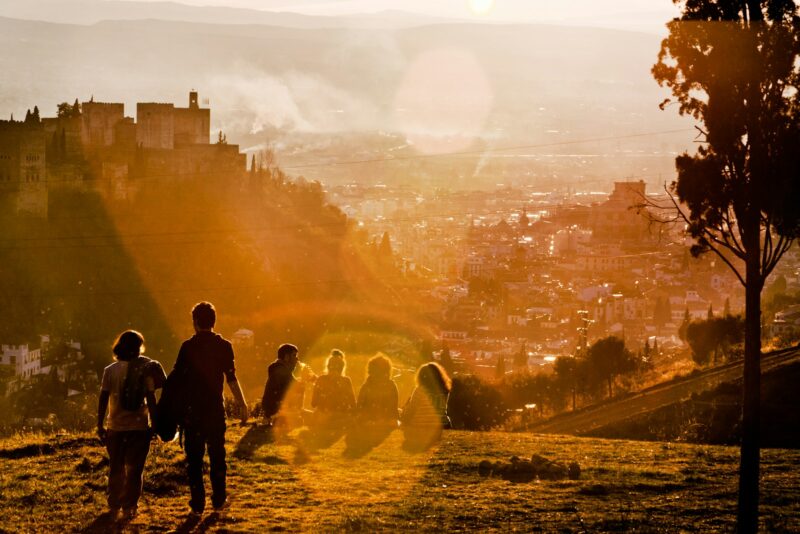
The reward for climbing is the view. The Mirador de San Nicolás is the most famous lookout point in Granada — a terrace that faces the Alhambra with the Sierra Nevada mountains in the background. At sunset, locals gather here with guitars, and the scene feels spontaneous but timeless.
For cyclists, the trick is to arrive earlier in the day, before it gets crowded. From the terrace, small lanes lead higher still, to lesser-known viewpoints like San Cristóbal and San Miguel Alto. These upper roads are narrower and rougher but almost empty. They reveal how close the Albaicín still is to the countryside — one side faces the dense city, the other opens to olive groves and dry hills.
Descending is the best part. The turns are tight, the streets uneven, but the sense of flow is unforgettable. You pass brick arches, tiled fountains, and balconies filled with flowers. The route ends near Plaza Larga, where locals gather for coffee or a glass of tinto de verano before lunch.
Into Sacromonte
Where the Albaicín ends, Sacromonte begins. The name means “Sacred Mountain,” and it rises steeply above the Darro River. For centuries, this area was home to Granada’s Roma community, who carved their homes into the soft hillside. These cave dwellings, or cuevas, are still inhabited today.
The road to Sacromonte climbs past the caves and small museums that explain how they were built. The most famous is the Museo Cuevas del Sacromonte, a short ride above the main street. Inside, you can see how each home used to function — kitchens cut into the rock, low ceilings, and whitewashed walls that stay cool even in summer.
The neighborhood is also the heart of Granada’s flamenco tradition. In the evening, several tablaos (performance venues) open in cave bars along the hillside. The sound of guitar and song carries through the valley, mixing with the smell of wood smoke and orange blossom.
For cyclists, the ride up here is short but steep. Many rent e-bikes from the city center to make the climb easier. Once at the top, the view back toward the Alhambra and the Albaicín is striking — the two old districts facing each other across the river, each holding centuries of stories.
Practical Details
Cycling through Granada’s hills is best done in the cooler months — spring and autumn are ideal. Summer afternoons can be hot, and most locals avoid cycling between noon and 4 p.m.
Surface conditions vary: cobblestones in the Albaicín, smoother pavement along the main roads, and compact dirt on some Sacromonte climbs. A sturdy city bike or e-bike is enough; mountain bikes are optional unless you plan to ride further into the hills.
Bike rentals are available in the lower city, and some offer guided half-day tours through both neighborhoods. Routes often include photo stops, short walking sections, and a drink break at a local café.
The full loop — from the city center through the Albaicín, up to Sacromonte, and back — covers roughly 10 kilometers but involves a lot of climbing and descending. It’s a compact but memorable ride that reveals how much character fits within a small urban area.
A Different Way to See Granada
What makes cycling in Granada unique is how close everything feels. You can move from medieval walls to cave houses, from shaded courtyards to panoramic views, in less than an hour. The city’s compact size and layered history make it ideal for exploring by bike, especially for travelers who prefer movement over sightseeing.
Several bike tours in Spain now include short urban rides like this as part of broader Andalusian routes. They connect Granada’s hills with the surrounding countryside, offering a way to experience both the energy of the city and the quiet of the olive groves beyond.
But even without a longer itinerary, the Albaicín and Sacromonte circuit stands on its own. It’s not just a route — it’s a look into how history still shapes daily life. The cobblestones, the terraced views, the sound of flamenco echoing from the caves — it all fits together in a way that feels distinctly, unmistakably Granada.