 The southern edge of Ljubljana looks like the city is about to end — neat suburban houses give way to flat land, open skies, and narrow farm roads. But this is where one of Slovenia’s most interesting landscapes begins: the Ljubljana Marshes.
Covering more than 150 square kilometers, the marshes form a broad wetland plain where rivers slow, fields flood, and birds return every spring. For cyclists, it’s a calm, open space that feels rural even though it sits just a few kilometers from the city center.
Unlike the mountain trails Slovenia is often known for, this is flat, easy riding — ideal for slow travel and for anyone who wants to see a side of the country that’s quiet but deeply tied to its history.
A Landscape Beneath the Surface
The marshes are not just farmland and reed beds. They’re built on layers of history. Archaeologists have uncovered wooden dwellings preserved in the mud, part of a prehistoric lake village system that earned the area UNESCO World Heritage status.
You won’t see the dwellings themselves, but the museum in Ig displays tools, pottery, and even parts of ancient canoes. The rest of the story is visible in the land itself — in the way ditches mark old watercourses, and wooden bridges trace the dry seasons when the wetlands shrink.
Cycling here means moving through a living museum of landscape change.
Getting Started
The best place to begin is in Ljubljana itself. The city’s cycling infrastructure makes it simple to get out — follow the Ljubljanica River south, past the modern neighborhoods and into the open plain. Within 20 minutes, the skyline disappears, replaced by wide views of distant hills and quiet country lanes.
Most riders head toward Črna Vas, a small settlement where the architect Jože Plečnik designed the Church of St. Michael. It’s one of the most unusual buildings in the region — modest but beautifully proportioned, made from local wood and brick. It’s also one of the few landmarks that rise above the flat horizon.
From there, the road becomes even quieter. Occasionally a tractor passes, or a stork drifts overhead, but otherwise it’s silence and the faint sound of the wind.
Life on the Marsh
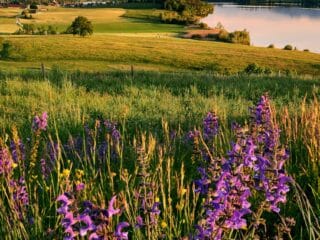
The people who live here manage a landscape that still floods each year. Their fields are small, often bordered by drainage channels dug generations ago. The mix of water and farmland attracts an impressive range of wildlife — frogs in spring, dragonflies in summer, herons and grebes along the canals.
There are few formal sights, but that’s what makes the ride appealing. You stop when something catches your attention: a wooden bridge, a flock of swans, or a roadside café serving homemade soup and bread.
In Ig, one of the main villages on the eastern edge, you’ll find a small museum dedicated to the marshes and a few good places for lunch. It’s also a good point to loop back toward Ljubljana or continue further south if you have time.
Optional Detours
The Iška River forms a narrow gorge just outside the marsh boundary — a short climb away, but worth it for a change in scenery. There, the water runs clear through rock pools surrounded by forest. It’s a favorite local swimming spot in summer.
If you prefer to stay within the wetlands, several wooden observation towers stand near the main routes. They’re good for short breaks and offer the only real elevation in the entire area. On clear days, you can see Mount Krim to the south and the outline of the Kamnik Alps far to the north.
Practical Details
The roads are mostly paved, though a few farm lanes use compact gravel. Any type of bike works, but many visitors rent e-bikes from Ljubljana to make the return trip easier.
Traffic is light, and signposts mark all the main cycling routes. The entire loop is around 35 to 45 kilometers, depending on how many side roads you explore. Water and food are available in small villages, though it’s best to bring a few supplies, especially outside summer.
The marshes are at their best from April to October, when the weather is warm and the fields are full of life. Early mornings often bring mist that hangs over the canals, while evenings are lit by soft orange light reflecting off the water.
The Local Perspective
Ljubljana’s residents see the marshes as their backyard — a place for weekend rides, running, and picnics. There’s a rhythm to it: families on city bikes heading out on Saturdays, older locals cycling to visit relatives, birdwatchers with binoculars strapped to their handlebars.
It’s not a dramatic landscape, but it’s one that reveals its detail slowly. The longer you ride, the more you notice — how the color of the soil changes, the smell of cut grass, the sound of water beneath the wheels.
This is everyday Slovenia, open and unhurried.
Why It’s Worth a Day
What makes the Ljubljana Marshes stand out is how accessible they are. You can finish breakfast in the city center and be surrounded by fields and birds within half an hour. The route is short enough for casual cyclists but varied enough to fill an entire day.
For many, it’s an introduction to the country’s wider network of trails. Several Slovenia bike tours use the marshes as their starting route before continuing toward the Karst region or the Julian Alps. It’s a reminder that in Slovenia, nature isn’t something far away — it starts right at the edge of town.