 Northern France and western Belgium share a landscape that remembers. Between Ypres, Passchendaele, and Poperinge, the fields are open and quiet, but the ground still carries traces of the First World War — old trenches, memorials, and small cemeteries framed by hedges and oaks. For cyclists, this part of Flanders offers a route that is as much about reflection as scenery: the Battlefields Loop.
The ride circles through the countryside west of Ypres, about 50 kilometers in total, following gentle farm roads and cycle paths that weave between villages. It’s not difficult — the land is mostly flat — but the distance between sites and stories makes it feel longer. This isn’t a loop for speed or challenge; it’s one for silence and space.
Leaving Ypres
Ypres is the natural starting point. Once destroyed during the war, it was rebuilt stone by stone into the same Gothic form it had before 1914. The Cloth Hall, St. Martin’s Cathedral, and the market square look centuries old, but every wall was reconstructed after the armistice.
Before setting out, most riders stop at the In Flanders Fields Museum, which explains how a small town became a global symbol of endurance. From there, a short ride leads to the Menin Gate, the vast arch engraved with the names of more than 54,000 soldiers whose graves were never found. Each evening at eight o’clock, locals still gather as buglers play the Last Post. The ceremony lasts only a few minutes, but it defines the tone for the rest of the route.
Through the Open Fields
Leaving Ypres, the road follows the Ypres–Comines canal before turning west into farmland. The fields stretch out in every direction, divided by straight hedges and narrow drainage ditches. There’s little traffic, just tractors and the occasional cyclist or horse rider.
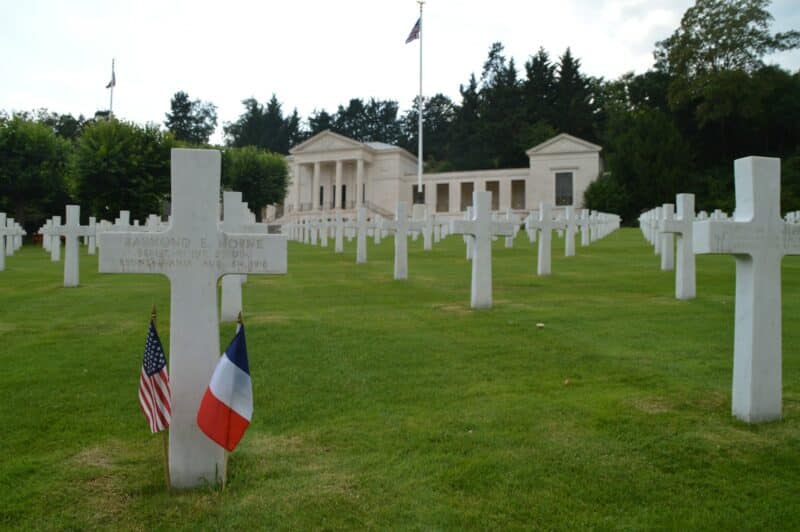
Every few kilometers, a sign points to a cemetery or memorial. Some are grand, others small enough to miss unless you look closely. Essex Farm Cemetery stands beside the canal, where John McCrae wrote the poem “In Flanders Fields.” Further on, Langemark German Cemetery holds a mass grave for tens of thousands of soldiers. The tone shifts constantly — British and Commonwealth sites are formal and bright, with white stone and symmetry; German ones are darker, shaded by trees and stone crosses.
The cycling itself feels effortless. The road surface is smooth, the wind light, and the silence deep. Every hill, however slight, opens a view over green plains where villages sit on gentle rises — each with a church spire, each with a story.
Passchendaele and Tyne Cot
At the northern edge of the loop lies Passchendaele, a name synonymous with mud and loss. The village itself is small and quiet now, with a school, a few houses, and the Memorial Museum Passchendaele 1917, which shows the battle’s scale in simple, factual displays. Behind the museum, reconstructed trenches let visitors walk through the same clay that trapped thousands of soldiers more than a century ago.
From here, the road climbs gently toward Tyne Cot Cemetery, the largest Commonwealth cemetery in the world. Nearly 12,000 soldiers are buried here, their graves facing the same flat horizon where the front once ran. On clear days, you can see Ypres’ church spires to the south — a straight line across what used to be no-man’s-land.
Cyclists often dismount here and walk. It’s not a rule, but something about the place encourages it. The air feels still, and the only sound is wind through the trees.
Poperinge and the Human Side
Heading west, the loop enters a softer landscape of hop fields and small farms. The road dips toward Poperinge, a town that served as a refuge for soldiers on leave from the front. Its squares and houses were far enough behind the lines to escape destruction, so they still look as they did a century ago.
Here, Talbot House offers a different kind of memorial — not to war itself, but to life within it. Founded by army chaplains in 1915, it provided a space for rest and normality, open to everyone regardless of rank. The house is still a guesthouse today, and cyclists can stop for tea in the garden or stay overnight in the dormitory rooms.
It’s a reminder that this region’s story isn’t just about death; it’s also about recovery, rebuilding, and the quiet persistence of daily life.
Returning to Ypres
The final stretch back to Ypres follows small lanes lined with willows. The sun, when it breaks through the clouds, turns the fields golden. Cows graze near drainage canals, and the land looks peaceful enough to forget what happened here — until another sign points to a cemetery just beyond view.
Most riders finish the loop by evening, returning to the town square as the bells of St. Martin’s begin to ring. The rhythm of the day feels complete: open fields, small roads, and the sense that history here is not distant but layered underfoot.
Riding with Respect
The Battlefields Loop isn’t a challenging ride, but it demands a different kind of awareness. The landscape looks simple, yet it holds more names, stories, and memories than almost anywhere else in Europe. The distance between memorials gives time to think, and the quiet of rural Belgium makes that reflection natural.
The infrastructure is excellent — well-marked cycle routes, small cafés, and train connections for those starting from Lille or Brussels. Spring and autumn bring the best light and mild temperatures; summer fields shimmer with green barley, while in winter, mist hangs low over the canals.
Many organized Belgium cycling holidays now include a day on this route, combining it with the coastal or cultural rides of Flanders. But even alone, it’s simple to follow — a self-guided journey through places that prove memory doesn’t always need monuments to endure.
Why It Matters
Cycling through Flanders’ battlefields shows how history can settle into the land without disappearing. Each road and field feels ordinary, but together they form a landscape of quiet remembrance. The war changed everything here, yet the people rebuilt without erasing what came before.
The result is not sadness but perspective — the realization that peace, too, leaves its own marks. You finish the loop not with a sense of mourning, but with gratitude that such silence can exist where chaos once ruled.