 In most places, mountain roads mean engines — the echo of cars and buses cutting through the quiet. In Switzerland, some of the most beautiful alpine towns chose a different path. Zermatt, Wengen, and Mürren are villages without cars, places where the rhythm of life moves on foot, by train, or by bicycle.
For travelers, visiting them feels like stepping into a parallel version of the Alps — one that’s cleaner, quieter, and more human-scaled. The mountains still dominate the view, but the absence of traffic changes everything: the air smells of pine and snow, bells from distant cattle carry through the valley, and time seems to slow just enough to notice it all.
Zermatt — The Iconic Pioneer
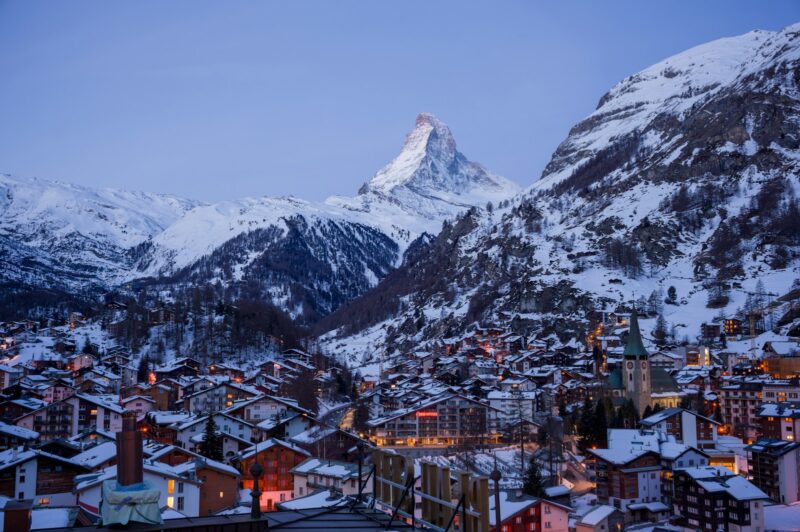
Zermatt is the best-known of Switzerland’s car-free resorts, sitting at the foot of the Matterhorn. The rule here is simple: no private cars. Only small electric taxis, hotel shuttles, and service vehicles are allowed within the town, all silent and compact.
Arriving by train from Täsch, the last car-accessible station, you step into a place that runs on precision rather than traffic. The main street hums with life — mountaineers with packs, skiers gliding to lifts, delivery carts moving quietly through the crowd.
Cycling in Zermatt is about access rather than speed. The lanes that wind through the town connect directly to trails leading up the valley. From the village, riders can follow the road toward Furi and Zmutt, where alpine meadows spread out beneath glaciers. Wooden barns and chalets line the slopes, their weathered facades dark from centuries of sun.
What’s striking is how calm everything feels. Even at its busiest, Zermatt never sounds like a city — the mountain air absorbs noise, and the electric vehicles glide almost silently past.
Wengen — Above the Lauterbrunnen Valley
While Zermatt sits at the end of a valley, Wengen floats above one. Perched on a sunny terrace overlooking the Lauterbrunnen Valley, it’s reached only by cogwheel train. The climb from Lauterbrunnen takes 15 minutes, winding through forests and waterfalls before opening onto the plateau.
Here, wooden chalets stand on green slopes facing the Jungfrau massif. The only sounds are footsteps, voices, and the occasional clatter of luggage being rolled to a guesthouse. The pace is steady, and the absence of vehicles makes it easy to notice details: the smell of fresh-cut hay, the distant echo of cowbells, the cool air flowing down from glaciers.
For cyclists, Wengen is more about e-bikes and local trails than long-distance routes. The roads within the village are short but connect to scenic paths across the ridge, including routes to Kleine Scheidegg, where the Eiger and Jungfrau rise close enough to feel their size.
In the evenings, the entire valley glows gold as the sun drops behind the peaks. From a balcony or terrace, you can see the trains climbing toward Jungfraujoch, tiny against the mountains — human engineering made small by the landscape.
Mürren — The Quietest of Them All
Across the valley from Wengen, Mürren might be the purest example of a car-free alpine village. It’s smaller, higher, and even more remote. You reach it by a combination of cable car and mountain train from Lauterbrunnen, and once you arrive, everything moves at walking speed.
The village stretches along a ridge with some of the best views in the Bernese Oberland. The north faces of the Eiger, Mönch, and Jungfrau fill the skyline like a painting. Cyclists can bring e-bikes up by train or rent locally, then explore short gravel paths leading toward Gimmelwald, another tiny settlement clinging to the slope below.
Mürren’s charm lies in its simplicity. Wooden houses stand shoulder to shoulder, their balconies stacked with geraniums. There’s no background hum of engines — just the wind and the occasional train bell. In the evening, people gather on benches to watch the last light on the mountains, as if the whole village pauses for the same view.
The Sound of Silence
What all these places share is not just the absence of cars but the presence of stillness. Without traffic, the human sounds return: footsteps on wooden bridges, voices echoing across streets, the steady rhythm of bicycle wheels on gravel. The experience changes how you perceive distance — five minutes’ walk becomes part of the day, not an inconvenience.
Shops, post offices, and schools adapt easily to the rhythm. Deliveries arrive by small electric carts or cable car freight lines. Residents move supplies by hand trolleys, a scene that looks unchanged for generations. In winter, snowplows run silently, clearing paths for pedestrians instead of roads for cars.
The result is not isolation but a kind of modern harmony — technology used to preserve calm rather than break it.
A Model for Slow Travel
Switzerland’s car-free villages aren’t designed as curiosities; they’re living communities. Tourism fits naturally into their structure. Visitors move through without disrupting the balance, and transport systems — trains, lifts, and ferries — interconnect seamlessly.
Several Switzerland bike tours now include stays in these villages, combining electric-assisted cycling with train travel between regions. Riders explore by day and return each evening to towns where streets belong to people rather than traffic. It’s a model of tourism that feels both sustainable and civilized.
Why They Matter
In an era of constant noise and motion, these alpine villages remind travelers that quiet isn’t emptiness — it’s presence. Without cars, everything else becomes more noticeable: the clarity of air, the echo of water through valleys, the texture of stone paths underfoot.
Zermatt, Wengen, and Mürren each show that progress and peace don’t have to conflict. They prove that mobility can coexist with silence — and that beauty often appears when you remove what distracts from it.
You leave not with souvenirs, but with the memory of sound itself: wind, bells, and footsteps. In Switzerland’s car-free villages, that’s the soundtrack that defines the Alps.