The southwest corner of the Netherlands is a place shaped by water. Between the North Sea and the lowlands of, roads run across dams, bridges, and reclaimed polders that exist only because people refused to give the sea the last word. Cycling here isn’t just scenic — it’s a quiet lesson in how a country built its identity on engineering and endurance.
The Delta Works Ride follows part of the massive flood defense system that protects the Dutch coast. It connects the islands and peninsulas of Zeeland through a network of causeways and dikes that now serve as safe, open cycling routes. The path runs through a landscape that’s part human design, part raw nature — saltwater estuaries on one side, flat farmland on the other.
A Ride Through Reclaimed Land
Most riders start near Middelburg, the capital of Zeeland, which still carries traces of its maritime past. From the city center, it takes only a few minutes to reach the open countryside. The first stretch heads toward Veere, a small harbor town with cobbled streets and a quiet waterfront. From there, a dedicated cycle path crosses the Veerse Gatdam — one of the first Delta Works barriers, built to control the tidal flow between the islands.
The view is pure Zeeland: flat horizons, a few distant wind turbines, and the constant presence of water. On windy days, the air smells faintly of salt and grass. The sea is never far, and neither is the story of how the Dutch kept it at bay.
What the Delta Works Are
The Delta Works were built after the North Sea Flood of 1953, a disaster that killed more than 1,800 people and submerged large parts of the Netherlands. Over the next 40 years, the country constructed a chain of dams, sluices, locks, and storm surge barriers — a system so advanced it’s now recognized as one of the great modern engineering achievements.
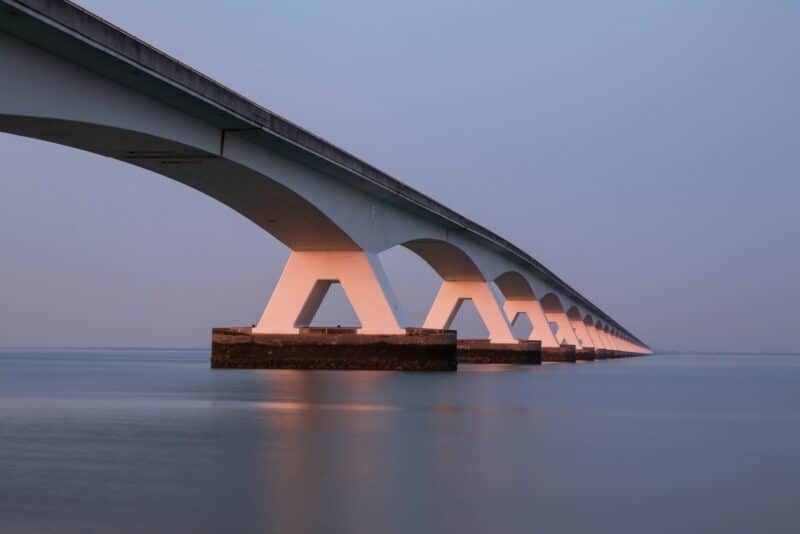
For cyclists, these structures aren’t just infrastructure; they’re part of the landscape. Long, straight causeways stretch across open water, offering uninterrupted riding with big skies and endless views. The experience is minimal and striking — a mix of nature, human design, and the sound of wind across concrete.
Crossing the Oosterschelde Barrier
The highlight of the route is the Oosterscheldekering, the largest and most famous of all the Delta Works. Stretching more than nine kilometers, it’s both a dam and a gate. Most of the time, seawater flows freely through its 62 massive openings, but when storms threaten, the gates can close within an hour.
Cycling across it feels almost surreal. There’s no city, no shops, no noise — just the sea on both sides and the occasional maintenance truck passing by. Halfway along stands Neeltje Jans, a small artificial island built during construction. Today it holds a visitor center explaining the flood and the technology behind the barrier. It’s worth a short stop to understand how much of the Netherlands lies below sea level — and how fragile that balance remains.
From the barrier’s midpoint, you can see seals resting on sandbanks and seabirds following fishing boats through the channels. The constant wind makes it a demanding but unforgettable stretch.
Beyond the Barriers
Past the Oosterschelde, the route continues south toward Zierikzee, one of Zeeland’s oldest towns. Its medieval harbor, brick gates, and narrow lanes make a good lunch stop. The main square fills with cyclists in summer, many doing the same route at different speeds — families with e-bikes, long-distance riders with panniers, locals on upright city bikes.
From Zierikzee, quieter rural roads lead to the Grevelingendam, another long causeway that connects to Goeree-Overflakkee island. The contrast between water and farmland is constant, and the ride has a steady rhythm — no major climbs, just wind direction deciding the difficulty of the day.
Wind, Water, and Silence
What stands out most on this ride isn’t a single view but the feeling of space. The Zeeland coast has an openness that’s rare in Europe. The roads are wide, the cycle paths immaculate, and the horizon seems to stretch forever.
Wind is a constant companion, sometimes a challenge, sometimes a gift. Locals say every ride here is a loop — you’ll fight the wind one way and fly with it the other. On calmer days, the sound of waves and the hum of tires on asphalt are the only noises you’ll hear for kilometers at a time.
The landscape may seem plain at first glance, but it changes with light and tide. Morning brings mist over the fields; afternoon sunlight turns the water silver. In summer, cyclists share the path with migrating birds resting on the mudflats.
Practical Notes
The complete Delta Works Ride can be done in a day, covering about 80 kilometers depending on detours. It’s mostly flat but exposed, so a steady pace and weather check are important. Spring and autumn are the most comfortable times to ride; summer can be windy but bright.
There are train connections from Rotterdam and The Hague to Middelburg and Zierikzee, and bikes are allowed on most trains outside rush hours. The infrastructure is excellent — clearly marked cycle lanes, regular cafés and rest stops, and accommodation ranging from campsites to small hotels.
Several cycling tours in Holland include the Delta Works as part of longer coast-to-coast routes. These itineraries often combine the ride with sections of the North Sea Cycle Route or the Zeeland Bridge, turning it into a two- or three-day journey through both engineering landmarks and small fishing towns.
Why It’s Worth the Ride
The Delta Works Ride isn’t just another coastal route. It shows what the Netherlands really is — not just canals and tulips, but a country that learned to live with water rather than fight it. Every dam, dike, and gate you cross tells that story in practical form.
You finish the day with a mix of tired legs, sea salt in your hair, and a quiet sense of perspective. The landscape might seem calm now, but it’s alive with history — proof that the Dutch relationship with the sea is never finished, only maintained.