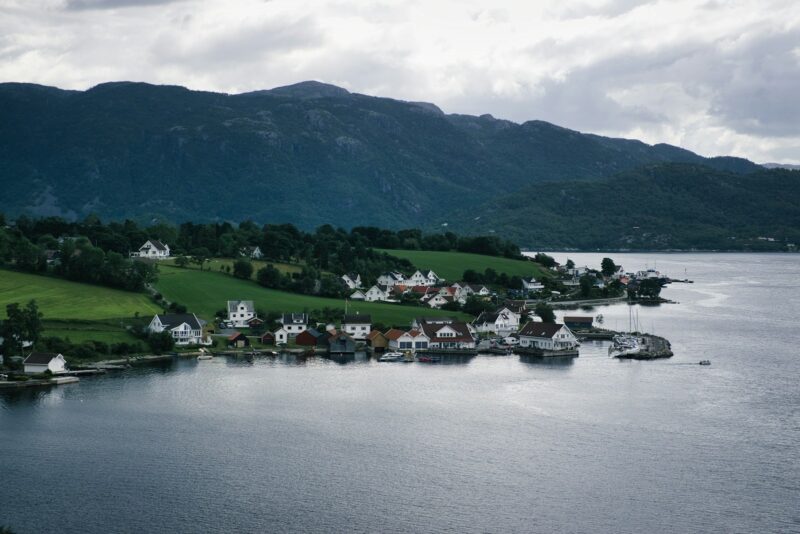
 Northern Denmark feels like a country within a country — quieter, flatter, and shaped by water on all sides. The Limfjord, a long channel of inlets and islands stretching across Jutland, defines this landscape. It isn’t a fjord in the traditional sense but a shallow sound, connecting the North Sea and the Kattegat. For cyclists, it’s one of Denmark’s most atmospheric routes: endless horizons, gentle winds, and small ferry crossings that link fishing villages and open fields.
The Limfjord Route (Limfjordsruten) follows roughly 600 kilometers of coastline, looping from the town of Hals in the east to Thyborøn on the western shore. Few travelers cover the entire route in one go — most ride a shorter section over two or three days. What stands out here isn’t the terrain, which is mostly flat, but the sense of openness. The road always seems to lead toward water, and the horizon never feels far away.
Between Sea and Sky
Starting in Aalborg, the largest city on the Limfjord, the route immediately leaves behind urban Denmark. Aalborg’s waterfront has been rebuilt with wide cycle lanes, cafés, and art spaces housed in old industrial buildings. Within minutes, you’re riding along quiet country roads lined with birch trees and red farmhouses.
Heading west, the scenery unfolds slowly. Low green fields stretch toward the water, interrupted by occasional wind turbines or church spires. The Limfjord’s edges are full of inlets and peninsulas that force the road to twist and turn, offering new views at every bend. The air smells faintly of salt, and on windy days the light shifts constantly, clouds sliding across the open sky.
It’s not dramatic riding — it’s steady and meditative. The surface is smooth, the traffic minimal, and the rhythm comes from the wind and the steady hum of the tires.
Ferry Crossings and Fishing Villages
One of the pleasures of cycling the Limfjord is the series of short ferry rides that break up the journey. These crossings are small — usually 10 to 15 minutes — but they feel like pauses between chapters.
At Aggersund, a small ferry links the northern and southern shores. The harbor smells of seaweed and diesel, and fishermen mend nets beside the pier. Across the water, the village of Løgstør welcomes riders with cobblestone streets and bright-painted houses. It’s known for its canal, dug by hand in the 19th century to improve shipping access, and for its shellfish — local mussels appear on every menu.
From Løgstør, the route runs west through salt meadows and bird reserves. The sound of gulls follows you almost the entire way. Small signs mark the Limfjordsruten, usually blue with a wave symbol — easy to follow without maps or GPS.
Small Towns and Simple Rhythms
Each town along the Limfjord has its own rhythm. Nibe, near Aalborg, is lively in summer with music festivals and marina cafés. Further west, Struer and Lemvig feel slower — market towns where people still greet strangers and the pace seems set by the tide.
The architecture is modest but beautiful in its simplicity: whitewashed churches, small harbors, and houses with thatched or red-tiled roofs. In the evenings, the light over the water turns silver, and the sound carries — church bells, dogs barking, a boat engine far away.
Cycling here is as much about atmosphere as movement. You don’t rush from one sight to another. You ride for the space, the quiet, and the occasional surprise — a seal resting on the shore, a heron lifting off from the reeds, or the sudden change in weather that turns calm water to ripples in minutes.
The Western Edge
The final section toward Thyborøn feels more rugged. The land narrows between the Limfjord and the North Sea, and the wind strengthens. Dunes appear, dotted with wildflowers and sea grass. The road runs close to the water, then climbs gently over low ridges with wide views of both coasts.
Thyborøn itself is a working harbor town, shaped by fishing and storms. It’s also the end of the Limfjord Route, where the fjord meets the ocean. The sea here is cold and restless, but the air feels clear and sharp. There’s a small monument to the 1959 flood — a reminder that, like much of Denmark, this land has always balanced between land and sea.
Many riders end their trip here with a ferry back east or a train connection to Aalborg. Others continue north into Thy National Park, a wilder landscape of heath, dunes, and pine forest.
Food and Rest
The Limfjord region is known for simple, honest food. Smoked fish, rye bread, and local cheese appear on every table. Farm shops sell honey, jam, and cider made from wind-sheltered orchards. In some small towns, cyclists can stay in bed & bike guesthouses — places that cater specifically to riders, offering secure bike storage, laundry, and breakfast early in the morning.
Camping is common, too. Denmark allows “shelter camping” — small wooden huts you can use for free in rural areas, usually near the water. They make the route ideal for travelers who want to move slowly without rigid plans.
A Different Kind of Coastal Ride
The Limfjord isn’t as famous as Denmark’s Baltic or North Sea coasts, and that’s part of its appeal. It’s quieter, less commercial, and more connected to the rhythms of daily life. Farmers wave from tractors, ferries run on trust, and cyclists share the road with almost no cars.
Several Denmark cycling holidays now include sections of the Limfjord Route, often paired with nearby islands like Mors or Fur. These small add-ons let travelers explore geological sites, fossil cliffs, and small vineyards that thrive in the fjord’s mild climate.
The ride doesn’t have a single headline attraction. Instead, it has continuity — a sense that every kilometer belongs to the same story of land reclaimed, maintained, and respected.
Why It’s Worth the Distance
Cycling the Limfjord is less about challenge and more about pace. It’s for riders who like the idea of following water, feeling the wind shift, and moving through a landscape that still feels genuinely local.
You finish with the impression of a region that’s not trying to impress anyone — it simply exists, calm and complete. The Limfjord may not be dramatic, but it stays with you long after the ride ends, as a place where Denmark’s openness — its landscapes, people, and way of living with the sea — feels perfectly in balance.